Perfectly crunchybroccoli & Brussels sprouts.
Two of the most misunderstood vegetables in the kitchen, and the five techniques that turn them into the dish everyone reaches for first. No special equipment, no long ingredient lists, and sauces that let the vegetable taste like itself.
“Taste and see that the Lord is good.” — Psalm 34:8
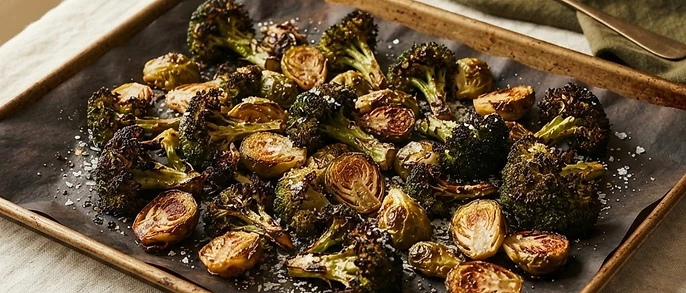
Crunch is not a recipe. It is dry heat meeting a dry surface.
Broccoli and Brussels sprouts are mostly water. Any water left on the outside, or trapped in a crowded pan, turns to steam — and steam is what makes these vegetables soft, sulfurous, and disappointing. Remove the surface moisture, give every piece space, use heat high enough to brown, and the sugars caramelize instead. That is the entire method.
Five techniques
Dry it completely
Broccoli & Brussels sprouts
Wash, then dry on a towel and let sit uncovered for 15 minutes. Cut broccoli into long florets with a flat side; halve sprouts lengthwise through the core.
Water on the surface steams the vegetable before it can brown. Dry heat is the entire mechanism of crunch.
High-heat air frying
Broccoli
Toss with 1 tbsp avocado oil and 1/2 tsp salt. Single layer, space between pieces. 400°F for 11 to 13 minutes, shaking once at the halfway mark.
Moving air removes surface moisture fast, so the tips blister while the stems stay crisp-tender.
Sheet-pan roasting, cut-side down
Broccoli & Brussels sprouts
425°F, flat sides touching the pan, no crowding. Broccoli 16 to 20 minutes; sprouts 22 to 26 minutes. Do not stir.
Contact with hot metal is what caramelizes. Stirring breaks contact and gives you soft vegetables with no crust.
Blanch and sear
Both, for a holiday table
90 seconds in salted boiling water, shock in ice water, dry well, then sear in a hot pan with oil for 3 to 4 minutes, undisturbed, until browned.
Par-cooking sets the color and lets you finish a large batch in minutes right before serving.
Shave raw
Brussels sprouts
Slice paper-thin with a knife or mandoline, dress with lemon and oil, rest 10 minutes before serving.
Raw ribbons keep their snap for hours and hold up beautifully on a buffet table.
Let the vegetablelead.
A good sauce here does two things: it sharpens the sweetness that roasting creates, and it adds richness without smothering the char. Every pairing below is built from real ingredients — oil, acid, a little sweetness, salt — with nothing from a can.

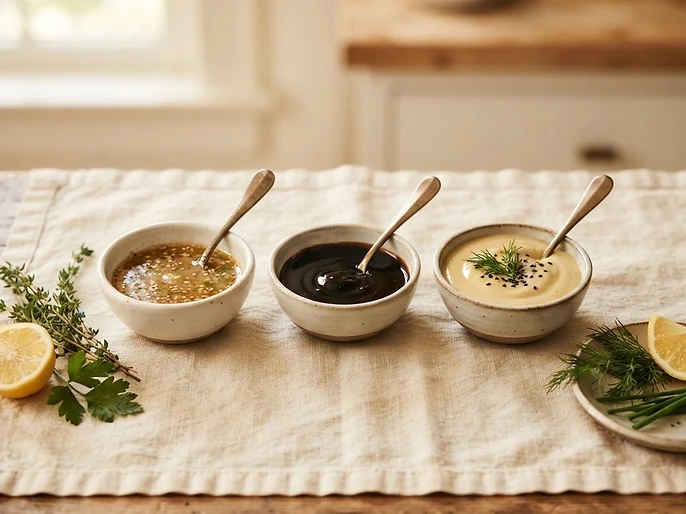
Rule of thumb: finish with sauce, never start with it. Sugar burns and acid blocks browning, so the sauce goes on after the heat is off.
Sesame-Ginger
BroccoliFresh ginger, rice vinegar, tamari, toasted sesame oil, a little honey
Warm through for 1 minute and pour over hot vegetables at the end so the crunch survives.
Lemon Tahini
BothTahini, lemon juice, crushed garlic, cold water, sea salt
Whisk water in a spoonful at a time until it turns silky; spoon over at the table, not before roasting.
Balsamic Glaze
Brussels sproutsBalsamic vinegar, raw honey, Dijon mustard
Simmer until it coats a spoon, then drizzle over sprouts straight from the oven with pomegranate and thyme.
Honey Dijon
Brussels sproutsDijon mustard, raw honey, lemon juice
Half before roasting, half brushed on for the final 2 minutes. Honey scorches above 425°F, so never all at once.
Garlic Lemon Butter
BothGrass-fed butter or olive oil, grated garlic, lemon zest, cracked pepper
Toss in the bowl while the vegetables are still hot so the garlic blooms without burning.
Chili-Lime Yogurt
BothPlain Greek yogurt, lime juice and zest, chili flakes, salt
Swipe across the plate first, then pile the hot vegetables on top. Cool against hot is the whole trick.
Five mistakes, and the fix.
Roasting wet florets
Dry them on a towel and let them air out. Damp vegetables steam and go limp every time.
A crowded pan
Use two pans if needed. Air needs to circulate or the vegetables release moisture and stew in it.
Stirring halfway
Leave them alone so the cut faces stay in contact with the hot pan. One flip at most, and only at the end.
Sauce added before roasting
Sugary sauces burn and acidic ones inhibit browning. Always finish with sauce after the heat comes off.
Under-seasoning
Vegetables need more salt than people expect. Salt in the pan and finish with flaky salt at the table.
Now put it on the table.
The technique is the hard part, and you already have it. Choose a recipe, choose a sauce, and let a vegetable be the thing people ask about afterward.